A Panoramic View of IoT Applications Through Typical Cases
I. Industrial Applications Represent the Core Value of the Internet of Things
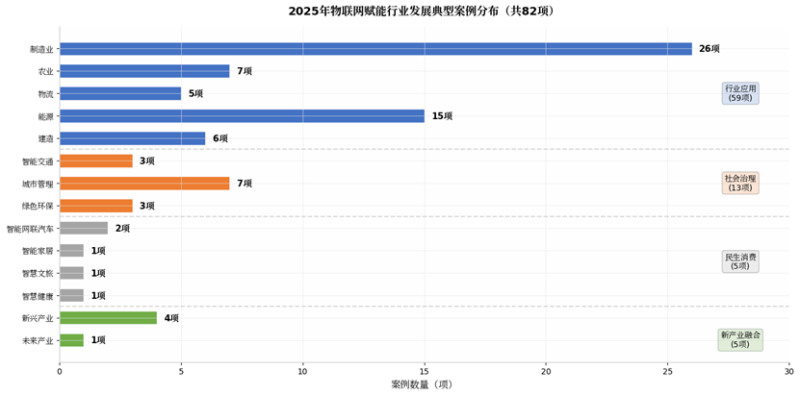
Manufacturing remains the dominant sector for industrial IoT deployment. Among the 59 industrial application cases released, 26 belong to manufacturing, accounting for 31.7% of the total. These cases showcase data-driven operation management powered by IoT in manufacturing scenarios. Representative examples include Midea’s AI-Driven Full Value Chain Collaborative Operation Based on IoT, Qingyanxunke’s Full-Space Perception and Digital Management of Personnel, Vehicles and Assets in Smart Factories, and Jiangxi Copper’s Comprehensive Digital Mine Control Platform. By collecting massive on-site production data via IoT connectivity and enabling data-based decision-making, these solutions realize the transformation of manufacturing management from human reliance to data governance. In addition, remarkable progress has been made in IoT-enabled unmanned factories, such as XCMG HanCloud’s Pilot Factory Construction for Construction Machinery and Linyi Iron & Steel’s Unmanned Stockyard, which effectively cut industrial production costs.
The energy sector contributes 15 cases, taking up 25.4% of the total. Key projects include China Pipe Group’s Full-Domain Collaboration Platform Empowering Smart Energy Ecosystems for Oil & Gas Pipelines, State Grid Zhejiang Electric Power’s Intelligent Supply Security of Source-Grid-Load-Storage for Mega-City Power Grids, and TGOOD’s Collaborative Smart Grid Architecture Integrating Vehicles, Power Grids and Cloud Platforms. These cases reflect the urgent demand for digital transformation in the energy industry amid the national dual carbon goals. Over the past decade, energy has long been a core application field of IoT, with widespread connectivity of various energy physical equipment. Modern smart energy systems cannot function without IoT technologies. A noteworthy case is China Southern Power Grid’s Dianhong: Construction of a Unified Power IoT System Built on Open-Source Architecture, which builds comprehensive equipment control capabilities based on an open-source ecosystem.
Other sectors are also represented, including agriculture (7 cases), construction (6 cases), and logistics (5 cases). A standout example is Maoshang Consumer Finance’s AIoT-Driven Digital Livestock Farming: Full-Link Empowerment for Smart Chicken Breeding. This solution forms a closed-loop business model for digital poultry farming rather than merely deploying IoT technologies. The smart breeding platform collects real-time data such as chicken weight, activity levels, and ambient temperature and humidity, and generates digital asset certificates combined with sales records. Serving as a "credit white paper" for farmers, the certificates resolve the pain point of lacking standardized financial statements. They help banks and insurance companies accurately assess business performance and risks, ease financing difficulties and high financing costs for farmers, and provide risk protection via insurance products.
II. Urban Governance Stands Out as a Core Segment of Social Governance
Thirteen cases fall under social governance, seven of which focus on urban management. While the number of urban management cases has declined compared with previous rounds, their proportion has risen sharply, indicating a shift in IoT-enabled social governance from extensive blanket coverage to targeted refined management.
Representative projects include Rizhao’s Smart Community Platform Powered by IoT Perception Networks and AI Agents, CCCC Sijtek’s Lightweight Monitoring System for Urban Bridges, Jiangsu Taihu Cloud Computing’s Intelligent Flood Monitoring for Urban Lifeline Infrastructure, and Zhejiang Heda Technology’s Leakage Early Warning System for Water Supply Pipelines. These solutions target critical safety pain points of urban infrastructure, marking an upgrade of IoT capabilities from simple visual monitoring to comprehensive standardized operation management.
III. Integration of Livelihood Consumption and Emerging Industries Pioneers New Future Living Scenarios
Only five cases are selected for livelihood consumption, with just one or two most representative projects retained for each subsector, such as All-in-One Computing On-Board Modules for Intelligent Connected Vehicles and Smart Elderly Care Cloud Platforms in the smart healthcare sector. In the author’s view, IoT application scenarios in livelihood consumption are far more abundant in practice, as IoT technologies have penetrated all aspects of daily life, making large-scale promotion via typical demonstration cases less necessary.
The "Integration with Emerging Industries" track was newly launched in 2025, featuring five cases in this round. Highlights include China Unicom (Liaoning)’s Smart Port Built on IoT and 5G Private Networks, Hainan Flyer Technology’s Cross-Domain Collaborative Autonomous Precision Observation Platform for Underwater Robots, and Hebei Jiuzhi Technology’s IoT-Enabled Biomanufacturing Solutions. This new track carries great practical significance. Nevertheless, the integration characteristics of emerging industries are not fully prominent in the collected cases this time. We look forward to more cases demonstrating deep integration between IoT and emerging and future industries, such as physical AI scenarios supported by IoT and low-altitude economy empowered by IoT technologies.
Core Characteristics of IoT Applications Reflected in Typical Cases
The 82 collected typical cases cover major IoT application fields, representing the deep integration of technological supply and market demand. They demonstrate distinct industry characteristics and provide references for the sustainable development of the IoT industry.
First, deep integration of AI and IoT has become an industry standard. More than 20 cases explicitly adopt AI technologies, including Midea’s AI-Driven Full Value Chain Collaboration, Rizhao’s IoT Perception Network plus AI Agent Platform, and China Energy Baoding’s Digital Intelligent Management of Thermal Power Infrastructure Powered by IoT and AI. These projects prove that AI enables IoT to evolve from raw data collection to autonomous decision-making. Even for cases without AI references in their titles, artificial intelligence functions are deeply embedded in practical operation. Relevant national policies have long mandated deeper integration of mobile IoT and AI, and the implementation of this requirement has accelerated in recent years.
Second, green low-carbon development, security and controllability have become top priorities. Projects such as Tianjin Kunpeng’s Energy Management System for Green Low-Carbon Logistics Parks, Zhejiang Chint’s Integrated Source-Grid-Load-Storage Near-Zero Carbon Park, and Inner Mongolia Environmental Investment’s Early Warning and Traceability Platform for Yellow River Water Pollution directly support national dual carbon strategies. IoT serves as a core technical pillar for carbon reduction through precise environmental monitoring and intelligent energy scheduling. Meanwhile, China Southern Power Grid clearly advocates building a unified open-source base to secure independent and controllable operating systems. In critical sectors including energy, autonomous and controllable IoT systems have become mandatory requirements.
Third, full-industry-chain collaboration is replacing isolated single-point equipment applications. Maoshang Consumer Finance’s full-link empowerment for smart chicken breeding and Jiuzhou Tong Pharmaceutical’s full-chain trusted traceability system illustrate the industry shift from individual device connectivity to digital collaboration across entire industrial chains. This trend also aligns with policy guidance to develop an integrated "solution + product + service" model and promote replicable industrial solutions with large-scale promotion value.
With continuous penetration across all sectors, IoT has evolved from a simple digital transformation tool for traditional industries into a fundamental production factor fostering new quality productive forces. The 2025 List of Typical Cases of IoT-Empowered Industrial Development serves as a microcosm of China’s IoT industrial applications. Looking ahead, driven by emerging market demands, deeper integration between large AI models and IoT, and continuous improvement of autonomous and controllable technical systems, IoT will play an increasingly critical supporting role in advancing new industrialization and building a Digital China.